Showing posts with label Contest. Show all posts

Sunday, March 12, 2017

How to Create Memorable Characters in Picture Books, Part 5

A relatable character connects with the reader.  

In HIRAM’S GIFT, I wanted to create a humble, caring, good-natured, hard-working character—easier said than done in the short text of a picture book. So I structured the book over a period of several years to showcase the Christmas gifts Hiram received as opposed to what he had hoped to receive. His reactions SHOWed his emotions and humbled nature, which works better than me TELLing them. He hoped for a fiddle but received a harmonica. He by-passed disappointment and embraced the idea of learning to play a harmonica with joy.
 
I try to custom build my characters to fit my story world and never base a fiction character on a particular person. If I use real people as a basis, the character is an amalgamation of several.
My goal is to hang a suitable name on the protagonist that fits the story and the time. Page or Armor are more appropriate names for the pet of a knight than Fluffy. Also, use a name the audience can easily read. "Pfogmoregetti" might fit the character, but the difficulty of pronouncing it forces the reader to stop and focus on the name, rather than the action. 

Characters give life to the story. Take time to know the character prior to writing. Focus on his/her uniqueness: hobbies, habits, fears, hopes, goal, temperament, vocal expressions, gestures, etc. A memorable character lives on in the minds of the readers after the book is finished. 

Call for Submissions for Young and Adult Writers:

Pearl S Buck Short Story Writing Contest!

§ Send your original and unpublished manuscript to The Pearl S. Buck Writing Center by April 15, 2017.

§ There are categories for children, teens and adults, and a winner in each will be awarded a $100 prize!

§ Grades 3-6 word count not to exceed 1000 words

§ Grade 7-12 word count not to exceed 1000 words

§ Adult word count not to exceed 2,500 words

§ This contest is open to everyone.

§ The winners will be announced at the 125th birthday celebration of Pearl S. Buck on June 26, 2017.

Submission guidelines at

https://psbwritingcenter.org/2017/01/18/2017-short-story-writing-contest/

Nancy Kelly Allen has written 40+ children’s books and a cookbook, SPIRIT OF KENTUCKY: BOURBON COOKBOOK. Check out her blog at www.nancykellyallen.com

Sunday, August 7, 2016

Editor Request to Rewrite

I’ve been fortunate this year to receive contracts on three books, possibly a fourth if my revision holds up to editorial scrutiny. About a month ago in my mailbox, I received a return on a manuscript, which usually means a rejection. Not this time. The editor asked me to change the character from an adult (king) to a child (prince) protagonist. Normally, my characters are children, but some popular pictures books of late have quirky adult character so I gave the idea a try.

My quirky character didn’t resonate with the editor but she liked the basic story with its universal problem, so she asked me to rewrite with a child as the main character. No problem. I’d change some narrative, some dialog, some events. Easy peasy!

As I began revising, I soon realized that what worked well for a quirky king didn’t work at all for a young prince. Much of the story (as it turned out, ALL of the story) was not appropriate for a child protagonist: the world view was too mature, the dialog didn’t fit the characters, and even the names had to be changed. 

So what does a writer do? This writer does a complete rewrite. When I completed the revision, about fifteen words matched the original story. That doesn’t mean that the text of the original has to be discarded. Mary Higgins Clark offered sage advice about cutting large blocks of text from a manuscript. She keeps it in a file to be used in a future book.   

Not only do I have a new manuscript, I now have a few bits of dialog and narrative in an old manuscript from which I can pull as some point. Those bits are gold in my literary vault. 

Call for submissions for Adult Writers

NewBBay’s Science Fiction Contest is open to all eligible writers submitting original works of 1,000 words or greater. We suggest a range of 1,000 to 30,000 words per piece, total. Each writer may submit up to two pieces. International entries are welcome, though submitted pieces must be in English. Writers must sign up at NewBBay.com, submit a “Writer Petition”, and post their work through our publication platform. Writers must include the word count and appropriate contest tag ( #SciFiContest ) in the description.

Deadline August 15, 2016.
Submission guidelines at http://www.newbbay.com/

Sunday, August 9, 2015

Journal, a Secret Weapon for Writers, Part I

A journal can be your secret weapon for writing. What is the best source for ideas? Life, of course. Things happen. Funny things. Sad things. Everything imaginable.

When you get an idea, write it down immediately. Keep a notebook handy for that purpose. If you overhear an interesting phrase or an unusual use of a word, add it to the notebook and allow a character to think those thoughts or use the phrase in dialog to add distinctive voice to your story. Story ideas pop up around us all the time. Make a habit to listen and look for possible plot ideas or interesting characters traits. You never know who will say or do something to make you think, laugh, wonder, or tease your imagination.
The idea or comment you write may not work for the piece you are currently working on but it may be perfect for a future project. If you fail to record information, you are more likely to not remember it, and if you write it on a scrap piece of paper, it may be lost. Get in the habit of collecting ideas for writing and place them where they are easily accessible,  such as a journal.
Sometimes I hear song lyrics and I think “That’s just what my character would say.” I have even pulled off the road to write in my journal.
A journal can hold the inventory you turn to when you need the extra oomph for your manuscript.
Call for Submissions for Adult Writers:
Brigantine Media’s Publish or Perish contest seeks authors who can help market their books.
Authors today must be more than authors. They also must take an active role creating a market for their books to have sales success.
We’ll let you in on a secret: today, publishers choose book projects based partially or entirely on the author’s ability to help in the sales process. We think it’s time to be honest about the need for authors to be marketers, too.
> Criteria
Submit your manuscript as well as your marketing ideas for the book. Entries will be judged 50 percent on the book’s content and 50 percent on the marketing plan for the book. Length limit: 150,000 words for the manuscript; 5,000 words for the marketing plan.
> Prize

The winner of the contest will receive a publishing contract and a $2,000 cash advance against royalties. The winner will receive the cash advance when he or she signs the publishing contract. And since we think the winning author will have a successful book, the winner agrees to give Brigantine Media right of first refusal on his or her next two subsequent books.
> Cost
There is no cost to enter the Publish or Perish contest!
> Important Dates
Entries will be accepted from April 15 through August 15, 2015.
The winner will be announced September 15, 2015.
Submission guidelines at http://www.publishorperishcontest.com/the-contest

Sunday, May 3, 2015

The Dreaded Synopsis

Writers need a one-paragraph synopsis of the manuscript for the cover/query letter and a one-page (or more, check guidelines for each publisher) synopsis for chapter books and novels. I find a synopsis anything but easy to write. Condensing the entire book into one paragraph or one page and retain the tone and voice of the manuscript is simply difficult. That’s not all. The summary should be intriguing, tantalizing, and irresistible in such a way the editor/agent wants to read the manuscript. A tall order, I must say.

One way to get an idea of what to write is to read blurbs on the jackets of books in a bookstore or library. Read lots of them. On-line, search publishers' websites and read book blurbs.
Let’s analyse a synopsis.
The goal is to introduce the characters and explain the basic overall plot in a few sentences. Begin with the main character. Who is s/he before the story begins? (If you don’t know this, interview your character to get to know him/her better).
What happened to create a problem for the character (inciting incident)?
What is preventing the character from attaining the goal? What made the plans fall apart?
What is the darkest moment, the time when it seems the character cannot possible achieve the goal?
What is the resolution? How does the character overcome the odds and prevail?
Next week, I’ll continue with information about writing a synopsis.
Call for Submissions for Young Writers:
I will resume providing this information in September.
Call for Submissions for Adult Writers:
Diverse Books Contest If you write MG and have a diverse background, including (but not limited to) LGBTQIA, people of color, gender diversity, people with disabilities, and ethnic, cultural, and religious minorities, you may be interested in submitting a short story to We Need Diverse Books. They are putting together an anthology of children’s literature to be published in January 2107.

Phoebe Yeh, VP/Publisher of Crown Books for Young Readers/Random House, has acquired publication rights to this Middle Grade WNDB Anthology, working title “Stories For All Of Us.”

The anthology will be in memory of Walter Dean Myers and it will be inspired by his quote: “Once I began to read, I began to exist.” Every new story contribution to this anthology will be by a diverse author.

WNDB is proud to announce that the anthology will have one story reserved for a previously unpublished diverse author. WNDB will fill that slot via a short story contest. The winner will be included in the anthology and will receive a payment of $1000 US.

MARK YOUR CALENDAR: The submission window is narrow, so if you want to submit you should start writing and polishing, but you can not send it in until April 27th 2015 when they start accepting submissions. The window for submissions is only open for 12 days (until 5:00PM EST on May 8th, 2015).
Short Story Rules

§ All submissions (short story or illustrated story) must be in English and never before published in any medium, print or digital.
§ Submissions must be no longer than 5000 words.
§ All submissions must be electronic and sent to the following email address: contest@diversebooks.org
§ All submissions must also be appropriate for a middle grade audience, ages 8 to 12.
§ If your submission is illustrated, it must be in a graphic novel format, but no longer than 10 pages.
§ Illustrations must be submitted electronically. Do NOT mail hard copy submissions to WNDB. They will not be reviewed, nor will they be returned.
Prizes
§ First prize winner will receive an award of $1000 plus their entry will be published as part of the WNDB Anthology to be released by Crown Books for Young Readers/Random House Children’s Books in January 2017.
§ Two runner-up winners will receive honorable mentions and awards of $250 each.

Sunday, April 5, 2015

A Contest for You, So Hurry!

I had planned to write about ways to trim excess words from manuscripts in today’s blog; instead, I’m trimming every word from that blog post and writing about a time-sensitive subject—free contests. I stumbled upon one this week that I want to bring to your attention. It’s a contest to win a free critique for a manuscript of any genre. Nice!

Contests are valuable ways to determine if your work has merit. If you win first, second, third, or honorable mention, your work has been validated by a professional. Woohoo! Even if you don’t win, you might get objective feedback. Not winning a contest does not mean your work has no merit. What does not work for one critiquer may work for another.
Judges are often agents and editors. Entering a contest gets your work in front of editors and agents in closed houses, publishers that are not open to unsolicited manuscripts.
Winning a writing contest gives you immediate credibility that can spruce up a resume. Some offer prizes—cash, classes, or critiques. Not bad.
Many contests are free. All that I post on this blog are no-fee. Most can be submitted online so the writer doesn’t even have to pay postage. Even better.
Before you enter a manuscript into competition, gather feedback from different people. Revise your work several times to make it sparkle before you submit it. Give your work the best opportunity to win.
Check out today’s Call for Submissions for Adult Writers for your chance to win a free critique. Good luck!

Call for Submissions for Adult Writers:
Canvas. We are seeking writers ages 13-18 to submit: 
Fiction – Please limit submissions to 5,000 words.
Novel Excerpts - Novel and memoir excerpts are acceptable if self-contained (work as a complete narrative).
Poetry – You may submit more than one poem, but please do not exceed 5 pages worth of poetry.
Plays - Please follow standard play format. Limit to 10 pages.
Nonfiction – Essays, memoir, creative nonfiction. Please limit submissions to 5,000 words.  
New Media – Video, images, etc fine for website. But must be accompanied by written version to be considered for print and eBook.
Cross-genre - Experimental work (prose poems, art and writing, fiction and nonfiction hybrids) are highly encouraged, but please keep to the word limit for fiction.
Call for Submissions for Adult Writers:
Barbara Kyle Critique. Want expert feedback about your manuscript? Then this contest is for you. It’s open to anyone with a work of fiction or narrative non-fiction. All genres are welcome. There is no fee to enter.
And here’s the great thing. If you win, you have up to a year to send your manuscript. If it’s ready now, that’s fine; send it as soon as you hear you’ve won. But if you need more time to complete it, that’s fine too. Winners will have up to a year to send their manuscript. Through Kyle’s mentoring she has launched many writers to published success, including bestselling mystery author Robert Rotenberg, historical novelists Ann Birch, Tom Taylor, and Barbara Wade Rose, award-winner Steven T. Wax, and debut novelist Marissa Campbell.
Now it’s your turn! Enter now for a chance to win an in-depth analysis of your work.
Prizes
♦ Grand Prize: Kyle's evaluation of a full manuscript – a $1,200 value
♦ Second Prize: Kyle's evaluation of a manuscript’s first 50 pages
♦ Third Prize: Kyle's evaluation of a manuscript’s first 25 pages
The manuscript evaluation will be conducted in a discussion with Barbara Kyle by Skype or by phone. The Grand Prize winner will get a full 2-hour discussion with me. The Second Prize winner and Third Prize winner will each get a half-hour discussion with me.
The evaluation will consist of an in-depth analysis of the manuscript in which Barbara Kyle will pinpoint the story’s strengths and weaknesses with regard to premise, structure, character development, voice, dialogue, setting, prose style, pacing, POV (point of view) and marketability. She’ll also offer suggestions on how any weaknesses might be improved.
1. Send a sample of your writing to Kyle at manuscriptcontest@gmail.com.
2. Maximum length of the sample: 1,500 words. Format: double-spaced, 12-point font.
3. The sample can be from your work-in-progress or a previous work.
4. Send the sample either in the body of your email or as an attachment in Word or PDF.
5. Include in your email your contact info:
  • your full name
  • your address
  • your preferred email address
  • your phone number (optional)
  • where did you hear about the contest?
  • Enter now! Email your sample at manuscriptcontest@gmail.com.
Deadline: April 30, 2015

Sunday, December 14, 2014

Today, I’m continuing the series “Ways to Improve Writing.”

Play with your memory. Relax. Think back to your childhood. What made you worry? What was fun?  What made you laugh, cry, or hide? The events that evoked your emotions are likely to do the same in readers.
Christmas is a time that floods my mind with memories. The sense of smell is the hardest to incorporate into a story; yet, the sense of smell is a vivid memory, especially when I think of Christmas: the spicy whiff of a fresh-cut tree from the hillside behind our house, the distinctive aroma of oranges, and turkey roasting in the oven. Mmmmmmmm. But one scent ranked above all others. The best smell in the world for this six-year-old gal was the enticing, magical fragrance of a new doll. Today, those enchanting aromas have the power to transcend me back in time in an instance and with only one sniff.
List a few memories from your childhood, maybe four or five. Toss them around to see if they could work as a children’s book. Use the memory as inspiration for the story, not the actual plot.
Mine your memories. Dig deep and write.
Call for Submissions for Young Writers:
Rattle We like poems of any length. Send up to four poems at a time. We’re looking for poems that move us, that might make us laugh or cry, or teach us something new. We like both free verse and traditional forms—we try to publish a representative mix of what we receive. We read a lot of poems, and only those that are unique, insightful, and musical stand out—regardless of style. Since our issues include about 70 pages of poetry, one of the main things we’re looking for is diversity; we have enough room to be eclectic, and we plan on using it. So while most magazines suggest reading their back issues to get a sense of what they like to publish, we’d suggest reading to get a sense of what we’re having trouble finding—if you notice a style or subject matter that we don’t seem to be publishing, send us that!
Call for Submissions for Young Writers:  
Clear Creek Writers 2014 Contest: Clear Creek Writers is having their second annual writers contest with hundred dollar prizes for both prose and poetry. As the contest is new, the contestants are limited and your chances are good.
Deadline: January 4, 2015

Sunday, October 19, 2014

Writing a Middle Grade Novel/Calls for Submissions

Today, I’m continuing the series, Writing a Middle Grade Novel.
Help! I’m suffering from stuck-itis on chapter 8. I’m staring at my plot outline and it just doesn’t seem to work. We’ve all been there, the place in out manuscript in which we wonder where to take out character next. The ideas in the outline no longer seem viable. We also read those books with a sagging middle, the excitement of the beginning just wanes and the story dulls rather than delights. What is a writer to do?
I asked some writer friends for advice.
Write. Just write. Ideas will begin to mesh and some will sparkle and work.
Don’t stress over the quality of your writing. All first drafts are bad. In fact, they stink. That’s what revision is for, to turn bad writing into good. At this point my manuscript is the literary equivalent of the aroma of limburger cheese. (Caution: No deep breaths, please.) Be content with the fact that you’re doing something right, you’re writing.
Put the story aside for a period of time. Give your ideas time to percolate and steep. Ideas need time to form. Later, you'll go back to the story with a fresh perspective.
In the meantime, begin working on a new writing project. When you return to the original story, you may be happy to discover that stuck-itis has changed to idea-itis.
Call for Submissions for Young Writers:
The Adroit Prizes for Poetry and Prose are awarded annually to two students of secondary or undergraduate status whose written work "inspires the masses to believe beyond feeling the work." In other words, we strive to receive the absolute best work from emerging young writers in high school and college, and the best of the best will receive these two lovely awards.We accept submissions for these prizes in the regular submissions pools throughout the entire year. For more information regarding submission at this time, please see our submission page.
The 2015 Adroit Prizes for Poetry and Prose will open for submissions on December 1, 2014, and will close on March 13, 2015.
Call for Submissions for Adult Writers:
Hopscotch is a magazine created for girls from 6 to 13 years, with girls 8, 9, and 10 the specific target age.
HOPSCOTCH looks for articles, fiction, nonfiction, and poetry that deal with timeless topics, such as pets, nature, hobbies, science, games, sports, careers, simple cooking, and anything else likely to interest a young girl. We leave dating, romance, human sexuality, cosmetics, fashion, and the like to other publications. Each issue revolves around a theme.
Submission guidelines at http://funforkidzmagazines.com/hs_guidelines

Sunday, February 16, 2014

Win a book. A picture book. My latest picture book, FIRST FIRE—A CHEROKEE FOLKTALE. 

Sign up for a chance to win. Tell others. Tell others to tell others. 

My publisher, Sylvan Dell, is giving away 5 copies. Here is the Goodreads link:


Thanks a bunch and good luck.
Let’s look at how to write a middle grade novel. 

Keep a log of character features. If the character has black hair in one chapter, s/he should have black hair in every chapter, unless you tell the reader otherwise. Stay consistent. Give the characters special quirks. Every person has unique quirks so let’s make our characters more realistic by giving them specific habits and behaviors. This uniqueness allows you to develop lifelike characters. This is much easier to achieve if you have a list of characters to which you can refer for their peculiarities.

 So, if you are writing about two or more characters the same age, how do you give each of them unique characteristics? Dialog works. As you read works by various authors, notice how they make characters sound differently. One character in my book has a habit of saying, “First thing.” Some characters might use few words to communicate and others may say in 20 words what could be said in 2. 

Another way to show individuality is with mannerisms. A character in one of my books twists her hair when she gets nervous. Maybe the a habit of interrupting others when they are talking could be used as a trait. The choices are unlimited.
 
All readers love to relate to the characters, and the middle grade audience is no different. Create weaknesses, problems and situations the characters must deal with and in which the readers can relate. The readers will see themselves reflected in the characters problems, actions and reactions.
 
I'll continue this series next week. 

Call for Submissions for Young Writers:
NATIONAL WILDLIFE FEDERATION CONTEST. This environmental journalism competition invites youth between the ages of 13-21 to report on topics related to the environment. Participants submit an article, photo, or video to the competition for a chance to win great prizes, plus national and international recognition. Deadline March 14, 2014. Prizes for the Young Reporters for the Environment USA 2013-2014 competition will be awarded in each media category (writing, photography and video) for each age group (13-15, 16-18, and 19-21). A first, second, and third place winner will be recognized in each category, for a total of 27 awards.


Call for Submissions for Adult Writers:
Ladybug is the Cricket Magazine Group literary magazine that targets children ages three to six. Its stories, articles, poems, and activities are fun and imaginative. It is open to submissions that use “clear and beautiful language” and have “a sense of joy and a genuinely childlike point of view.” For fiction, editors look for very well crafted original pieces or folk and fairy tale retellings (to 800 words). The are particularly interested in receiving stories set in cities or foreign places. Ladybug nonfiction (to 400 words)

explores the places in a child’s daily world, nature, science, and cultures. Rhythmic or rhyming poetry of current interest (to 20 lines) also deals with children’s “daily lives and their emotional and imaginative worlds,” or are action rhymes that encourage movement. 

Submission guidelines at www.ladybugmagkids.com


Sunday, January 5, 2014


I’m so happy to have Alison Davis Lyne back this week. Alison is a creative illustrator with a stack of picture books claiming her art. She’s been working professionally since 1996. You can check out more of her work at www.lyneart.com. She writes the column “Art Tips” for the SCBWI (Society of Children’s Book Writers and Illustrators) Bulletin.

 Alison, tell us about your process of designing art for the text of a book. 

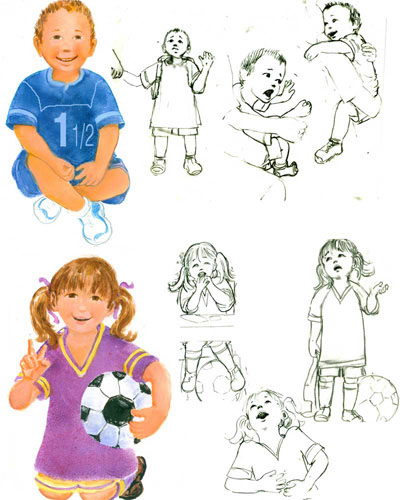
I begin by thinking about how the individual characters will look and act. That will often lead to a character study page like this: 


This is a character page from my most recent book, Little Things Aren't Little When You're Little written by Mark Burrows, and published by Pelican Publishing. 

All of this work is for “my eyes only,” and is used just like a writer's text outline, and character sketches. I then work up and send on final black and white sketches to the Art Director.  After doing any revisions that the Art Director requests.....I begin the “funnest” part of the job (at least for me)....painting the final artwork. 

You, as the writer, can polish your PB manuscript with this exercise. When you have reached a semi-final stage of your manuscript, you might take 16 sheets of paper, and number them front and back 1 thru 32.  Usually the text for a book starts on something like page 5. You might try to divide out blocks of text on the pages of your “book” spread over pages 5 thru 32. See if you can structure the action and rhythm of your text to flow easily over page turns and double page spreads.  This is “for your eyes only”, NOT to be sent to a publisher. 

This exercise can be a great way to smooth out some of the story line, word plays and rhythms. And it will “show” when an editor reads your manuscript. You can bet that editors reading your manuscript will be thinking along the same lines.....and that can't help but be a “good thing” when an editor is evaluating your manuscript for publication.

Alison, thanks for the great tip on how to structure page turns to keep the energy, flow and interest levels high in the text we write for our picture books. I look forward to another visit from you this spring.

Call for submissions for young writers:

Vademecum Magazine is a student-run high school literary print publication. The quarterly magazine publishes poetry, prose, and black-and-white photography that "illuminate aspects of the everyday that are frequently unseen, un-ogled, unappreciated." This is a non-paying market. Submission guidelines are here.
Submission guidelines at http://www.vademecummag.com/#!submissions/cihc

Call for submissions for adult writers:
 The American Kennel Club contest. Entries must be original, unpublished stories that have not been offered to or accepted by any other publisher. Only one entry per author.

The American Kennel Club retains the right to publish the three prize-winning entries in AKC FAMILY DOG, or other AKC publications. Entries may feature either a purebred or mixed breed dog. The maximum length is 2,000 words. Entries exceeding that length will not be considered. No talking dogs, please. 

Entries must be printed on 8 1⁄2″ x 11″ white paper, one side per page, double-spaced. Poor-quality or faded copies cannot be considered. The author’s name, address, and phone number must appear on the first page. The author’s name and the page number must appear on each successive page. 

All acceptable entries will be read by a panel of judges selected by AKC Publications. They will choose the winners based on the style, content, originality, and appeal of the story. All decisions are final. Winners will be announced in an issue AKC FAMILY DOG in 2014.

Send entries to:
AKC Publications Fiction Contest
The American Kennel Club, 260 Madison Avenue, New York, NY 10016
DEADLINE: ENTRIES MUST BE POSTMARKED BY JANUARY 31, 2014

Check out more contests on my blog: http://nancykellyallen.blogspot.com/


Sunday, February 12, 2012

Keep Them Laughing/Call for Submissions/Contest

Wouldn’t you love to know what type story an editor is looking for? That would certainly put us a step ahead of the competition. Many editors say they don’t know what they’re looking for until they see it. Oh, well, there goes that idea. But one aspect of writing most editors are looking for is humor. Like editors, children of all ages enjoy humorous books.

Writing humor for children can be difficult. What is funny to a two-year-old may seem silly and boring to a five-year old. Humor must be geared to the child’s world so he will know and appreciate the words, actions, and plot. The child must understand what is happening before it the story can be appealing and funny. Humorous writing is difficult because what is funny is often subjective and personal. One reader may crack up laughing at a joke and another might see little or no humor in the text. Even though writing humor can be difficult, it is not impossible.

Here are some ways to create humor in books for children:

1. Dialog offers an opportunity to add humor seamlessly. “We’ll be batburgers!” is a line one of my characters said when lost in a cave.

2. Humorous narrative creates interest in a story. Another of my characters, Liz, is telling the story in The Munched-Up Flower Garden so her thoughts are expressed in a way to tickle the reader. I looked at my brother and said nothing. My look must have said plenty because he hightailed in back in the house.

Next week, I’ll discuss other ways to incorporate humor into stories.

Call for Submissions for Adult Writers:
Kaleidoscope Magazine, which “creatively focuses on the experiences of disability through literature and the fine arts,” is planning an issue “on the theme of ‘Appreciating the Small/Simple Moments in Life.’ In the midst of our daily struggles there can be moments in which a small kindness, or the simple gesture of another, makes us feel as if all is right with the world. They are the instances that usually do not involve much, if any, preparation or planning. These are the small things that can make the biggest differences. These can be times of joy experienced in the midst of sadness, or of peace and contentment in the midst of chaos. They can be shared or solitary experiences, moments of transcendence that fulfill us. They are also those moments that, if we are not paying attention, can slip right past us. Share one or more of those moments with us, in poetry, fiction, or personal essays.” Deadline is March 1, 2012. Pays: $10-$125. See http://www.udsakron.org/news/detail.asp?id=10 for more information

Contest for Young Writers:
PUBLISH-A-KID CONTEST-We invite young readers to write book reviews. Winning entries will be published in the pages of Moment. And yes, there will be prizes. We’ve selected a list of books for you to choose from. Pick one
or more that you enjoy or find intriguing and tell us why! Anyone ages 9-13 is eligible. We encourage children of all faiths to enter. Each review should be 1 to 2 pages double-spaced, 250-500 words. Each child can send one review for each book on the list.
Deadline: Deadline February 15, 2012.
Details at http://momentmag.com/moment/contests/pak.html

Check out more contests on my blog: http://nancykellyallen.blogspot.com/

Sunday, February 5, 2012

Reflecting Real Life in Writing


Exciting news. My latest picture book, Big C and Little Ox, arrived this week. Big C, a cape buffalo, is a loner, quite grouchy, and has almost nothing say. Little Ox, a busybody oxbird, is the opposite: loves to jabber, always in a happy mood, and enjoys company. So what do the two have in common? They have a symbiotic relationship: Little Ox picks off fleas that keep Big C from itching; in turn, Little Ox gets lunch. But one day, Big C and Little Ox have a quarrel and Little Ox leaves. For Big C, a lesson about friendship unfolds.

My primary goal in writing fiction is to entertain, but I always add layers of meaning into the storyline. In this book, readers will learn about getting along with others who are different, the dependent relationship of a cape buffalo and an oxbird, and the importance of friendship. Plus, it’s packed with humor.

Humor is the universal language all kids enjoy. Parents and teachers do too. I strive to write so my stories have layers of understanding. The younger child will laugh at the grumpiness of the cape buffalo and his antics. Older readers will appreciate the acceptance of a friend who is different. Friendship is a theme everyone can relate to in some capacity.

Nearly all of my writing reflects real life. I don’t mean specific events or people, but things that are important to me. Animals rank high among my interests. The writer in me enjoys researching and writing about animals in a voice kids will enjoy.

Call for submissions for adult and student writers:
An essay competition for adult and student writers commemorates the 50th anniversary of the publication of Rachel Carson’s Silent Spring. Two prizes will be awarded: a “Junior Prize” of $1,000 for essays 1,000 words (or less), which is open to students aged 13-18; and a “Senior Prize,” conferring $2,000 for 2,000 words (or less), which is open to anyone aged 19 or over.” Questions to spark your essayistic response are posted on the website. There is no entry fee.
Deadline: March 15, 2012.
Details at http://www.carsoncenter.uni-muenchen.de/about_rcc/silentspring_essay/index.html

Sunday, December 11, 2011

Improving Word Choice/Contest/Call for Submissions

In children’s writing, especially picture books, every word must be necessary so the importance of word choice is paramount. How do we learn to develop a writing style in which we select the best words for the story?

Read widely. Let books by numerous authors serve as a learning experience. Notice how authors choose particular words to convey an idea.

Write in a variety of styles. Try using figurative and lyrical language in all types of writing.

Keep sentences clear. Short sentences are less confusing. If you use longer sentences, retain the meaning by writing in a direct manner. Clear, precise, detailed writing gives life to words. The goal is communication.

Avoid clichés and stereotypes. “Mad as a wet hen” is a cliché and the words don’t resonate with a fresh expression. If you write your first thoughts when describing something, you may be using clichés. Play with the words to develop your own phrases for comparison. Avoiding stereotypes isn’t easy but aim for writing original phrases and descriptions.

Vary sentence length. A paragraph composed entirely of long sentences tends to bog down a story. Varied sentence lengths adds interest to the flow and pace of the words.

Experiment. Try writing the same story using different perspectives. If the story is about a lost cat, try telling the story from the child’s point of view. Retell the story from the cat’s perspective. Which works better?

Have fun. After you get past the dreaded first draft, have fun with the words. If the story is playful, choose upbeat words. The best choice of words will reflect the tone of the story.

Contest for Adult Writers
Dream Quest One Poetry & Writing Contest.
Write a poem, 30 lines or fewer on any subject or write a short story,
5 pages maximum length on any theme, single or double-line spacing,
neatly hand printed or typed.
Writing First Prize: $500, 2nd: $125; 3rd: $100
Poetry First Prize: $250, 2nd: $125; 3rd: $50.
Entry fees: $5 per poem, $10 per story.
Postmark deadline: December 31, 2011.
Details at http://www.dreamquestone.com


Call for Submissions for Student Writers
New Moon Magazine
34 Superior Street, Suite 200
Duluth, MN 55802
800-381-4743
www.newmoon.org
75% written by girls, ages 8-14: fiction, non-fiction,
poetry, book reviews and articles.

Check out more contests on my blog: http://nancykellyallen.blogspot.com/

Sunday, November 27, 2011

Creating Character Motivation, Contest, Call for Submissions

Fictional characters must be motivated to make a change. The motivation determines how the characters respond to the world around them. Interesting characters take action that creates change.

The character should desire something. Maybe it’s winning a blue ribbon or the heart of the girl of his dreams or finding something s/he lost. The possibilities go on and on. The quest to fulfill that desire is the story.

The path the character takes in fulfilling the desire is based on the background you develop: personality traits, view of the world, setting, etc. Is the character strong and powerful, weak but determined, easy going or defensive? Figuring out the background of the character before beginning the story helps the writer make plausible choices that fit the character. The reader will understand why the characters made those choices.

Reveal the motivation slowly through action and dialog rather than in large chunks, called backstory. If the character has a purpose for his/her behavior, the reader is more interested in following along.

Have you ever seen a friend act in a way that was unusual for that person? You might thing s/he was acting out of character. Of if the friend does something that was full anticipated, you might say, that’s Karen being Karen. Apply the same viewpoint to fictional characters. Is the behavior consistent with the character? If the character isn’t behaving typically, readers have to know why. Make the motivation clear and readers will connect.

Contest for Adult Writers:
PIXELHOSE FICTION AND NONFICTION WRITING CONTEST
Categories fiction, nonfiction (creative or essay). $300, $150 and $50 prize monies in each category. Limit 5,000 words. Previously published works are accepted so long as pixelhose.com can legally obtain free, one time, one site, permanent web publication rights. The contest may be extended at pixelhose.com discretion until a minimum of 500 entries have been submitted.
Deadline December 7, 2011.
Details at http://pixelhose.com/fiction-and-nonfictio-writing-contest/

Call for Submissions for Student Writers:
Seventeen Fiction Contest
Open to female writers, ages 13-21, in the US and Canada. Word Count: 500 words. No entry fee.
Grand prize: $5000 and publication in Seventeen.
Deadline December 31
Details at http://www.seventeen.com/fun/articles/fiction-contest