Showing posts with label picture book. Show all posts

Sunday, December 5, 2021

Here’s a peek at my latest picture book. BUGS ON THE JOB is a hive of activity. Fireflies are deLIGHTtful. Beetles break down rotting wood. They’re TREEmendous workers. Dung beetles are super scoopers. They save the earth from piling up with you-know-what. Bees are responsible for one out of every three foods people and animals eat. Honey, that's BEEutiful! 

BUGS ON THE JOB will be available in January and at that time, I’ll have a book signing at the Read Spotted Newt Bookstore in Hazard. The book signing date will be announced soon. If you are local and can’t attend the book signing, contact Mandi at readspottednewt@gmail.com and she will reserve a book for you. 

Those who are not local can preorder on the website www.thelittlefig.com on this page https://thelittlefig.com/.../bugs-on-the-job-coming-soon

The book will be available beginning January 1st at www.thelittlefig.com and will be available through the distributor APG Sales and Distribution in Nashville beginning February 1st. 


Holding a new book is the ultimate thrill for writers. We’ve poured our hearts, along with smidgens of sweat, and trickles of tears, into the work for months and years. From the time a picture book is accepted for publication, a two-year stint is in order to revise, tweak, and wait, and wait, and wait. The effort is worth it.

Sweat and tears morph into chills and thrills as writers meet fans of their literary “babies.” The publication date is approaching quickly, and I’m ready. 


Writing tips:

If you’re writing a picture book or a short story, keep the number of characters small. BUG ON THE JOB has two characters per page, and occasionally a third character, a flower, pops up.

Dialog breathes life into the characters. Allow your words to show a character's personality.

Add humor. Every reader loves it.

Add conflict. The flower gives power to conflict in this book.


Nancy Kelly Allen has written 51 children’s books and a cookbook, SPIRIT OF KENTUCKY. Check out her blog at www.nancykellyallen.com

 BUGS ON THE JOB, Nancy’s latest picture book will be available in January 2022.

Check out her blog at www.nancykellyallen.com


Sunday, February 17, 2019

“Write” Start: Action


Action is another way to open a story, whether it’s a picture book, chapter book or YA novel. The official term is in media res, Latin for “in the midst of action.” Delving the reader into the exploits of the main character establishes the stakes at risk and ups the tension. I used this style of opening in FORTY WINKS. A dragon zoomed around the child’s room at night, waking him. 

Opening a story with action places the reader in the middle of the scene as it is taking place. It’s been used for centuries, as far back as the Roman poet Horace who stated that an epic poem should not begin “from the egg” but should “snatch” the listener “into the middle of things.” It kicks the story off in the middle of the plot. 

To begin with action, something happens. The action may be near the beginning of the story, or closer to the middle or ending. The writer then backtracks to introduce the character and the situation.

Call for Submissions for Young Writers:

The Louisville Review accepts accepts submissions of previously unpublished poetry from students in grades K-12. Seeks writing that looks for fresh ways to recreate scenes and feelings. Honest emotion and original imagery are more important to a poem than rhyming and big topics—such as life, moralizing, and other abstractions. Parental signature must accompany submissions. Unsolicited submissions of fiction, poetry, nonfiction, and drama year round. All work must be previously unpublished. Reply time is 3-6 months. Simultaneous submissions are accepted, but please notify us promptly via email if your work is accepted elsewhere. All submissions are considered based on quality of writing above all else.

Submissions guidelines at http://www.louisvillereview.org/submissions/

Call for Submissions for Adult Writers:

East of the Web. East of the Web is keen to provide exposure for writers by offering them a place where their work will be seen and read in a high quality, respected setting. The site receives about half a million unique visitors per month, so successful submissions are likely to be viewed by more readers than in almost any other short story publication. In addition, the site receives attention from agents, the press, film makers, schools, universities and other publishers.

Submissions guidelines at http://www.eastoftheweb.com/short-stories/Publishing.html


Nancy Kelly Allen has written 40+ children’s books and a cookbook, SPIRIT OF KENTUCKY: BOURBON COOKBOOK.

Leave a message or check out my blog at www.nancykellyallen.com


Sunday, March 4, 2018

Getting Ideas and Writing a Book


I had the wonderful opportunity to visit with students at an elementary school last week. Such visits inspire me to write more and to the best of my ability. Students' interest and questions spur me on.
Two questions in particular resonated: How long does it take to write a book? How do you find ideas to write about?
I wrestle with an idea anywhere from a week to years (thirteen years, as in the case of AMAZING GRACE). DEAR KOMODO DRAGON, my latest picture book, required less time, about two years.
When I visited the Louisville Zoo, I saw a Komodo dragon named “Big Man.” At nearly eight-feet long, he lived up to his name. This king of the lizards wagged a long, yellow tongue and shuffled every step. A close look and a bit of imagination conjured my first instinct:  write about this animal, whose ancient ancestors dated back millions of years. The species had staked its claim on planet Earth and held tight. A story had to be in there somewhere.
I wrestled with the idea of how to write about this amazing animal in a way that had not been done. A few days later, I talked with a group of young students about what they enjoyed. One young girl said she loved to receive letters, but almost never did. The others echoed her, voicing the excitement of receiving their own mail.
The two ideas—Komodo dragons and letters—simmered, scrambled, and stuck together. Out popped a brand new idea: a book about a Komodo dragon pen pal. Once I figured out the structure—a series of letters—I began brainstorming and outlining the plot. Since I knew almost nothing about Komodo dragons, I spent a lot of time researching facts. I gathered a basket full of information. From that, I selected the most interesting facts that would appeal to the readers.
Each book is different and the amount of time to write a book varies.
Call for Submissions for Young Writers:
Storybook Online. Tons of activities including writing stories, read original stories, create interactive stories and much more.
Call for Submissions for Adult Writers:
Blue Mesa Review accepts previously unpublished work in Fiction (up to 6,000 words), Nonfiction (up to 6,000 words), Poetry (up to 3 poems), and Visual Art. We have a rotating editorial board, so each issue is fresh and unique. In general, we are seeking strong voices and lively, compelling narrative with a fine eye for craft. We look forward to reading your best work!
Submissions guidelines at https://bluemesareview.submittable.com/submit

Nancy Kelly Allen has written 40+ children’s books and a cookbook, SPIRIT OF KENTUCKY: BOURBON COOKBOOK.

Leave a message or check out my blog at www.nancykellyallen.com


Sunday, October 22, 2017

Writing Children’s Books with Child Appeal, Part 2

Fictional picture books often deal with the character solving a problem, and in doing so, the writer’s job is to show the character’s emotional state. A character’s feelings are the gateway into the story.  Emotions make readers feel, make them hunger for the character to overcome the obstacles, and cheer for the victory. Without the emotional stakes, readers are not drawn into the character’s world, so they don’t care. Make readers feel. Make them care. With each scene, consider how the reader will react. Is the event something in which the child can identify? If children see themselves in a story, they identify with it and request it for storytime, over and over. 

Mountains of children’s books have been written on every subject that interest children of every age. Making a book different in some way so it can compete in a highly competitive market is necessary. One way to do this is to write about some thing or experience in which a child is familiar and flip it to present the information or story in a fresh and engaging way. A retelling of a fairy tale from the voice of a minor character: Example: Cinderella as told by the pumpkin or the glass slipper.  

Page turns are fun for the readers and add a ton of child appeal. This approach keeps adding surprises as the story unfolds. Here are three ways to add page turns.

1.      Stop in the middle of a sentence and complete it on the following page. Readers enjoy this because it allows them to predict what my happen next. The more a reader is engaged in a story, the more appeal it has.

2.      Use part of a compound word on one page and the remainder on the next. Example: He found a rattle…snake in the grass.

3.      Transitions words are fun to heighten the interest of turning a page: then, when, but, etc. 

In my next blog, I’ll continue with more ideas for writing books with child appeal.

Nancy Kelly Allen has written 40+ children’s books and a cookbook, SPIRIT OF KENTUCKY: BOURBON COOKBOOK. Check out her blog at www.nancykellyallen.com 

Call for Submissions for Young Writers:
KidSpirit accepts submissions of poetry, artwork, and nonfiction articles from 11- to 17-year-olds everywhere. Except for artwork, all work should be related to the following themes:
Unity and Division (Fall 2017)
Creation and Destruction (Winter 2017/18)
Submission guidelines at https://kidspiritonline.com/get-involved/ 

Call for Submissions for Adult Writers:

One Teen Story is a literary magazine for teens and adults who read young adult fiction. They publish 12 issues a year digitally and in print. Each issue contains only one story.

They pay their authors $500 dollars and 25 contributor copies for first North American serial rights. The rights revert back to the author after publication.

Submission guidelines at http://www.authorspublish.com/one-teen-story-now-open-to-submissions/Nancy Kelly Allen has written 40+ children’s books and a cookbook, SPIRIT OF KENTUCKY: BOURBON COOKBOOK. Check out her blog at www.nancykellyallen.com

Sunday, August 27, 2017

Trends

If you’ve been writing or reading children’s literature for a few years, you’ve probably noticed some changes. Let’s look what editors and agents are seeking:

Graphic novel style of writing has moved into the picture book arena.

Short picture book manuscripts, 500 words or less, are hot property.

Middle grade stand alone and series. Historical fiction remains popular.

In middle grade and young adult books, authentic characters take on real world issues.

Diverse books and diverse voices from around the world are sought by agents and editors.

Fantasy is still fashionable in young adult books.

Nonfiction books retain their popularity.

Biographies of the famous and the not-so-famous are in vogue.

Retelling of folktales are, once again, in demand.

A constant in children’s literature is the author who writes original stories with authentic voice and laugh-out-loud books.

Call for Submissions for Adult Writers:

805. Awaiting Your Masterpiece. We can't wait to see your work!  We seek writing and art that is unexpected, striking, and moving. We accept submissions from residents of Manatee County as well as the rest of the universe. We take submissions from debut, emerging, and established authors and artists.
Art & Photography

Five at a time
Fiction or flash fiction 

One at a time, max 2,500 words
Creative nonfiction

Two at a time, max 2,500 words each

 Graphic fiction/nonfiction

Two at a time, max 8 pages each

Submission guidelines at http://www.805lit.org/submissions

Nancy Kelly Allen has written 40+ children’s books and a cookbook, SPIRIT OF KENTUCKY: BOURBON COOKBOOK. Check out her blog at www.nancykellyallen.com


Sunday, June 18, 2017

Picture Book Revision, part 2

            Tips on revision, continued:

My thought processes rely heavily on verbs that don’t show action: is, are, was, were…. In revision, I eliminate many of the non-action verbs and replace them with other verbs that paint a specific picture (pedaled, skipped, barked). Action verbs don’t need modifiers, so fewer words are needed to describe the scene.
Add rhythm. Alliteration (fog floated) makes the prose livelier. Onamonapia (bumpty-bump) adds a beat that sounds like poetry when read aloud. Rhythm is how the words connect, a rise and fall of the phrases and sentences.
Less dialog. Picture books don’t rely heavily on dialog. Usually, dialog is no more than 1/3 of the text, often much less. Rather than conversations, use action scenes that can be illustrated with the narrator relating the action. The targeted audience is young children who prefer fast action to character conversation, which often slows the action. Of course, this is a general rule. Some books have no dialog, and some are all dialog.
Let the illustrations tell part of the story. Picture book writers have to think visually. When I write a first draft, I include scenes that describe illustrations. In revision, I study each word, phrase, and sentence; then, delete everything down to the bare action. Sometimes I cut so much, I have to add it again to make the story understandable. Picture books are short and the stories are to the point.
Every page in the book must show action and the pace is usually fast. After writing the first draft, I divide the manuscript into 13 scenes. Each scene must show action. If not, more revision is required.
Next week, I’ll add more tips.
Call for Submissions for Adult Writers:

Narrative is strongly committed to supporting our authors’ work. Our current rates for work are as follows:—$150 for a Story of the Week, with $400 each for the annual Top Five Stories of the Week.
—$150 to $350 for 500 to 2,000 word manuscripts.
—$350 to $1,000 for 2,000 to 15,000 word manuscripts.
—Rates for book-length works vary, depending on the length and nature of the work.
—$50 minimum for each accepted poem and audio piece. ($25 for poetry reprints.)
—$200 each for the annual Top Five Poems of the Week.FIRESIDE
Submission guidelines at http://www.narrativemagazine.com/node/360

Sunday, April 16, 2017

How Long Does It Take to Write a Picture Book?

The number one question I’m asked about writing: How long does it take to write a picture book?  

Of all the writing questions I’m asked, that one is the hardest to answer. In a measurement of time, do I include the conceptual preparation, that phase when I consider countless obstacles the character can encounter? Or do I begin with the first time I place pen to paper or fingers to keyboard? From the origin of the idea to the first written word of the manuscript may consume weeks, maybe months. The character lingers, like the sweet aroma of a cake baking, in the oven of my mind. As the idea jells (or curdles), I sometimes write notes on the character, plot, and single phrases; I sometimes let them hang out and tantalize my senses, with scenes etching into my brain before I begin stringing words on paper. 

I’ve been keeping notes on one particular character that has been marching around my thinker for a few weeks. Today, I took action and began writing the manuscript. So is this day one or day fifty-seven?  

After rewriting the first draft, a second, a third…at some point, whenever it is fairly polished, I’ll send it to my critique partner. I’ll polish again and place it aside for a month or so. During that time, I’ll think about it occasionally, cognitively making changes, as I work on another manuscript. Do I count those days? 

I don’t keep track of my time; however, some authors do. They log their time on each project and can answer the question posed here in actual days/hours/minutes. I’m not that time-task oriented. My mind tends to wander off track too often to keep a time log; instead, I have to admit: I don’t know the answer. But this I know: The time it takes to write a picture book varies with every book and every author.

Call for Submissions for Young Writers:

Canvas Teen Literary Journal was established and 2013 and publishes quarterly in print, ebook, web, video, and audio formats. It is seeking work by writers aged 13 to 19 and accepts fiction, novel excerpts, poetry, plays, nonfiction, new media and experimental cross-genre work. Canvas asks that all submissions be previously unpublished but it will make exceptions for work that was published in a school literary journal or a personal website.

Submission guidelines at http://canvasliteraryjournal.com/submit/  

Call for Submissions for Adult Writers:

GIRLWORKS: The “magazine for smart girls” aged 11-15 years. Focus on all issues facing girls. Articles: 400-800 words.


Nancy Kelly Allen has written 40+ children’s books and a cookbook, SPIRIT OF KENTUCKY: BOURBON COOKBOOK. Check out her blog at www.nancykellyallen.com

Sunday, January 8, 2017

Is Your Picture Book Manuscript Ready to Submit?

Is Your Picture Book Manuscript Ready to Submit?

Picture books are designed to be read aloud. So if you are wondering if your manuscript is ready to send to an editor, try reading it aloud first. By reading aloud, you hear the flow, the pacing, of the story. You also hear what the eyes don’t always see: mistakes. Reading aloud helps to identify parts of the story that may be difficult to speak. Do you have a string of words with initial sounds that trip the tongue? This example, “sixth sick sheik’s sixth sheep’s sick,” is extreme but the idea is to make the words flow, not twist in the reader’s mouth. 

Do you have a hook for the story? In a query letter, the hook provides your story’s introduction to the agent or editor. The hook should include Character + Problem/Obstacle + Theme. This was the hook I wrote for an upcoming book picture book, HIRAM’S GIFTS: “Hiram builds fires to heat the two-room schoolhouse and earns dimes for his trouble. With a heart full of hope, he saves his money in a sock and thumbs through a catalog looking at a shiny fiddle, a maple fiddle, the kind of fiddle he dreamed of playing. Tragedy strikes.” 

When writing a hook, capture the theme of the story without giving away the ending. The purpose of a hook is to convey the protagonist’s journey and plot, as well as showcasing the writer’s style, in a concise manner.  

Did the character change or grow in some way from the beginning to the ending? Did the story allow the central character to become empowered? The answers to these two questions should be “yes.” Did the influence resulting in the change and empowerment come from a childlike perspective? Reasoning and world view should reflect that of a child. 

Call for submissions for Young Writers

Canvas Literary Journal. We are seeking writers ages 13-18 to submit:

 Fiction – Please limit submissions to 5,000 words.

Novel Excerpts - Novel and memoir excerpts are acceptable if self-contained (work as a complete narrative).

Poetry – You may submit more than one poem, but please do not exceed 5 pages worth of poetry.

Plays - Please follow standard play format. Limit to 10 pages.

Nonfiction – Essays, memoir, creative nonfiction. Please limit submissions to 5,000 words.  

New Media – Video, images, etc. are fine for website. But must be accompanied by written version to be considered for print and eBook.

Cross-genre - Experimental work (prose poems, art and writing, fiction and nonfiction hybrids) are highly encouraged, but please keep to the word limit for fiction. 

Submission guidelines at http://canvasliteraryjournal.com/submit/ 

Call for submissions for Adult Writers

Enchanted Conversation. Each of the six submission periods for 2017 will have a theme. Here they are: January: "Steadfast Tin Soldier," March: "Diamonds and Toads," May: "Donkeyskin," July: "Emperors New Clothes," September: "Godfather Death," November: "Elves and the Shoemaker."
When each window for submissions opens, a theme-related post will be published. Please read the relevant post before writing your submission. All of the themes are classic fairy tales, but I do not want slavish retreads of the original stories. At the same time, your works should reflect the chosen theme, or there is no chance of publication.


Nancy Kelly Allen has written 40+ children’s books and a cookbook, SPIRIT OF KENTUCKY: BOURBON COOKBOOK.

Sunday, December 18, 2016

Picture Book Savvy, Part 3


Picture book text keeps getting shorter. A couple of decades ago, the target number for most publishers was 1000+. Not today. In order to write a successful picture book for traditional markets, the action has to be distilled into as few words as possible. The story idea should be weighty to provide a narrative tale with a beginning/middle/ending, leave space for illustrations to tell part of the story, and connect with the audience in a positive way.  

Rhythm and cadence are essential, and word choice is the key. Follow your own voice by telling the story as only you can. Write in such a way that your unique storytelling rings throughout. That’s what will define your career. 

Editors are looking for fresh voices, stories that make them stop to reread a sentence and offer something to make them continue reading the next. They want to be enlightened, amused, enthralled, baffled by the actions or questions posed. This does not come from the first draft. Every story needs to be revised until its patina glimmers. 

Revision takes time. Give your manuscript some time off. Walk away and work on another story. This absence is vitally important in order to review your work later with fresh eyes.  

Hand your glimmering draft over to a set of new eyes. Find a critique partner who has read lots of books and who is a practicing writer. Feedback from an informed writer helps you understand what works and what does not. 

One of my dad’s favorite authors, Louis L'Amour, said it this way: Start writing, no matter what. The water does not flow until the faucet is turned on.  

Call for submissions for Young Writers:

Hanging Loose Magazine welcomes high school submissions.

* Send all work to High School Editor, Hanging Loose, 231 Wyckoff Street, Brooklyn, NY 11217. Please also send us a note identifying yourself as a high school age writer, and telling us
your age, and be sure to include a self-addressed stamped envelope with sufficient return postage.
* Send 3 to 6 poems, or 1 to 3 short stories, or an equivalent combination of poetry and
prose. This enables us to get a good idea of what your work is like.
* All work should be neatly typed. High quality photocopies or readable computer-generated
hard copies are acceptable. A brief biographical statement is welcome. We are always interested in knowing how you found out about us, what school you attend, and so forth.Please Note: We prefer to receive submissions from young writers themselves, rather than from their teachers. We strongly discourage teachers from submitting samples of work from members of their classes. Similarly, we discourage teachers from asking students to submit their work as a class assignment. We prefer teachers to encourage students who take themselves seriously as writers to write us directly.

Hanging Loose has long been known for its special interest in new writers. We read manuscripts throughout the year and we look forward to reading yours.


Call for submissions for Adult Writers:

Storytime Magazine. From spring 2017, we’ll be publishing one new short story in every Storytime issue, which will be credited to its author. If your story is selected, that’s your name and your creation in print forever – and beautifully illustrated to boot! Not only that, but you’ll be part of Storytime’s mission to keep short stories alive and to help children fall in love with reading for pleasure!


Nancy Kelly Allen has written 40+ children’s books and a cookbook, SPIRIT OF KENTUCKY: BOURBON COOKBOOK.

Sunday, March 22, 2015


Today, I’m thrilled to have picture book author, Stephanie Burkhart, as a guest. Stephanie grew up in Manchester, New Hampshire. She currently works for LAPD as a dispatcher and has two additional books, The Giving Meadow and First Flag of New Hampshire.
Nancy:  Welcome, Stephanie. I’m so glad to have you here today to discuss your latest book, Brady’s Lost Blanket
Steph: Thank you for having me. I’m happy to share my book and writing experience with others. In Brady’s Lost Blanket, Brady is a sensitive young boy who takes a blankie wherever he goes. After traveling with his parents to visit his new cousin, Brady accidently leaves his blanket behind.
 Nancy: This book can be quite useful to parents whose child has had a similar experience. What was the hardest part of writing it?
 Steph: I find that children's stories are truly inspired and when the story comes, it comes quickly. There was nothing "hard" about it.  Even the editing of the story went smoothly. I suppose there's a lot of anxieties of letting an illustrator you don't know illustrate the story, but 4RV uses a great set of illustrators and Bridget McKenna did a wonderful job with the illustrations.
 Nancy: For me, writing picture books is extremely difficult. I love how the writing process evolved quickly and smoothly for you. What advice would you give to those who want to get a publishing contract for a manuscript?
Steph: Study writing. Understand the craft of writing: point of view narration, description, and using an economy of words. Draft bios so you get to know each character before you start writing. I take at least two weeks to prep a novel by researching characters, setting, historical background, and drafting a flexible plot.  Before I submitted my novel to a publisher, I entered it in the Writer's Digest Annual Contest. They're looking for short stories with a word count of 4k and under. Writing short stories teaches you to use an economy of words. When you submit to publishers, be patient. The publishing world is a "slow" business and nothing happens overnight. Be patient.
Nancy: Being patient is a must. A picture book, once accepted by a publisher, usually takes at least two years for publication. How did you develop the idea for this picture book?
 Steph: One of my husband's relatives told me a story about her grandson, how he was attached to his blankie and how it was hard for him without it.  I recalled my own childhood and how I was attached to my blankie.  It was a security crutch, but there's a time to let the blankie go.  It's like your first step to growing up.
I wanted to write Brady's Lost Blanket for those kids who have blankies and might be reluctant to give them up.  I hope the story is inspiring and helps children understand there are other things you can fall back on when you don't have your blankie.
 Nancy: I’m sure readers will enjoy this story. I certainly did. What did you enjoy most about writing the book?
 Steph: I enjoyed crafting a story that wouldn't be too "preachy." I think a lot of children will identify with Brady because the story is one that kids with blankies can understand.
 Nancy: You’ve written a wonderful story. Where can readers find your book?
 Steph:  Amazon:
Nancy: Stephanie, I wish you much success with Brady’s Lost Blanket. Thank you for sharing your literary experiences.
Call for Submissions for young Writers:
Magic Dragon Magazine. Work should be neatly printed or typed. If you type it, please double-space. Stories and essays can be up to three pages, poetry up to 30 lines. It is ok to send writing that you have also illustrated. You can write about anything that is important to you; it can be serious or funny, true or fiction. If you send originals and want them returned, enclose a stamped, self-addressed envelope.
You may send writing by e-mail to magicdragonmagazine@gmail.com. Be sure your writing or art has your name and age with it and an e-mail address where you can be reached.
Permission to Publish – Each piece of writing or art must have a “Permission to Publish” form attached. (Teachers – If you are submitting work from a class, please be sure each piece has a Permission to Publish form.)
Published Work – Each writer and artist whose work is published in Magic Dragon will receive one copy of the issue in which the work appears.
Call for Submissions for Adult Writers:
Blaze magazine is full of fun facts, cool games and crafts, and fascinating articles on horses, horse kids and the natural world they share. Promoting literacy of course, it’s great for learning about not only horses, but also about nature, history, creative arts, character traits and much more. Geared for kids aged 8 to 14, the magazine is published quarterly. And what’s more, Blaze is also a real-life horse. She’s a flash Rocky Mountain and the official mascot of the magazine. Subscribers call her their own! Pays 25 cents/word.
Submission guidelines at http://blazekids.com/about-2/

Sunday, January 5, 2014


I’m so happy to have Alison Davis Lyne back this week. Alison is a creative illustrator with a stack of picture books claiming her art. She’s been working professionally since 1996. You can check out more of her work at www.lyneart.com. She writes the column “Art Tips” for the SCBWI (Society of Children’s Book Writers and Illustrators) Bulletin.

 Alison, tell us about your process of designing art for the text of a book. 

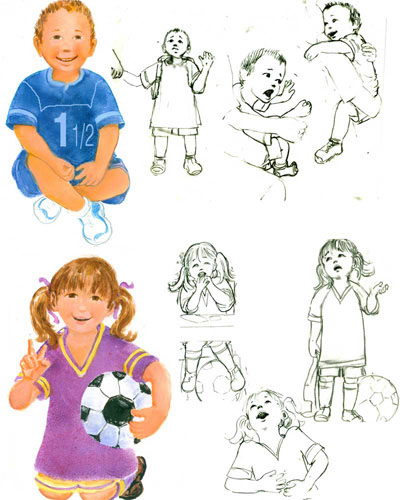
I begin by thinking about how the individual characters will look and act. That will often lead to a character study page like this: 


This is a character page from my most recent book, Little Things Aren't Little When You're Little written by Mark Burrows, and published by Pelican Publishing. 

All of this work is for “my eyes only,” and is used just like a writer's text outline, and character sketches. I then work up and send on final black and white sketches to the Art Director.  After doing any revisions that the Art Director requests.....I begin the “funnest” part of the job (at least for me)....painting the final artwork. 

You, as the writer, can polish your PB manuscript with this exercise. When you have reached a semi-final stage of your manuscript, you might take 16 sheets of paper, and number them front and back 1 thru 32.  Usually the text for a book starts on something like page 5. You might try to divide out blocks of text on the pages of your “book” spread over pages 5 thru 32. See if you can structure the action and rhythm of your text to flow easily over page turns and double page spreads.  This is “for your eyes only”, NOT to be sent to a publisher. 

This exercise can be a great way to smooth out some of the story line, word plays and rhythms. And it will “show” when an editor reads your manuscript. You can bet that editors reading your manuscript will be thinking along the same lines.....and that can't help but be a “good thing” when an editor is evaluating your manuscript for publication.

Alison, thanks for the great tip on how to structure page turns to keep the energy, flow and interest levels high in the text we write for our picture books. I look forward to another visit from you this spring.

Call for submissions for young writers:

Vademecum Magazine is a student-run high school literary print publication. The quarterly magazine publishes poetry, prose, and black-and-white photography that "illuminate aspects of the everyday that are frequently unseen, un-ogled, unappreciated." This is a non-paying market. Submission guidelines are here.
Submission guidelines at http://www.vademecummag.com/#!submissions/cihc

Call for submissions for adult writers:
 The American Kennel Club contest. Entries must be original, unpublished stories that have not been offered to or accepted by any other publisher. Only one entry per author.

The American Kennel Club retains the right to publish the three prize-winning entries in AKC FAMILY DOG, or other AKC publications. Entries may feature either a purebred or mixed breed dog. The maximum length is 2,000 words. Entries exceeding that length will not be considered. No talking dogs, please. 

Entries must be printed on 8 1⁄2″ x 11″ white paper, one side per page, double-spaced. Poor-quality or faded copies cannot be considered. The author’s name, address, and phone number must appear on the first page. The author’s name and the page number must appear on each successive page. 

All acceptable entries will be read by a panel of judges selected by AKC Publications. They will choose the winners based on the style, content, originality, and appeal of the story. All decisions are final. Winners will be announced in an issue AKC FAMILY DOG in 2014.

Send entries to:
AKC Publications Fiction Contest
The American Kennel Club, 260 Madison Avenue, New York, NY 10016
DEADLINE: ENTRIES MUST BE POSTMARKED BY JANUARY 31, 2014

Check out more contests on my blog: http://nancykellyallen.blogspot.com/


Sunday, December 29, 2013

Today, I’m so happy to have the talented illustrator, Alison Davis Lyne, visit my blog. She has illustrated picture books and has an art column in the SCBWI (Society of Children’s Book Writers and Illustrators) newsletter.  

Just WHAT Does An Illustrator  DO?? 

When an illustrator is chosen to illustrate an author's PB manuscript, it's the beginning of a working partnership between the publisher, writer and illustrator. Most of the time the writer has already done the work of writing the manuscript and any revisions that the publisher suggests. When the publisher is satisfied with the manuscript, the Art Director and Editor will chose an illustrator that fits the tone of the manuscript and the publishing house's “look.” 

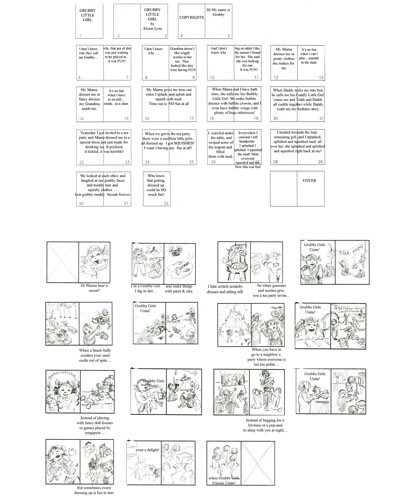
When I get a manuscript, I immediately begin reading and planning how I think the picture book ought to look. Every illustrator has a different work flow, but I usually start out by laying out the text of the manuscript on a 32 page “book chart.” I continually change it up as I also start very rough sketches, or thumbnails. You can see an example of how I work this below. 


The thumbnails take but a moment to change so it's easy to try out different ideas, and discard them just as easily if they don't work out. Very much like writers make up a outline of how they want the story to flow.....and can change it quickly with each plot change. 

Here are some of the books Alison has illustrated:

Halloween Alphabet

Thanksgiving Day Alphabet

Easter Day Alphabet

Kudzu Chaos

G is for Grits

Little Things Aren’t Little When You’re Little 
 
Alison is making a return visit next week. She will explain an exercise that writers can do to improve the action and flow of their picture books.  

Call for submissions for young writers: 

KidSpirit Online is a free teen magazine and website for kids that
empowers youth everywhere to tackle life’s big questions. KidSpirit
provides a creative internet publishing outlet for teens around the
globe to share original essays, poetry and artwork.
Call for submissions for adult writers:
Enchanted Conversation: A Fairy Tale Magazine is an online publication for ages 13 and up. It publishes 2 pieces each month—story and/or poem. Authors receive a $25 gift certificate.


Check out more contests on my blog: http://nancykellyallen.blogspot.com/