Showing posts with label sentences. Show all posts

Sunday, May 26, 2019

Becoming and Staying Productive with Writing


We’re ending the fifth month of the year. Back in January, many writers had manuscript ideas popping and cracking as if trying to explode onto paper. The passion was sizzling. But as we write and the sentences don’t flow quickly or in any semblance of rhythm, the flame of passion for writing can cool to an ember, if that.

This happens to many writers, including me. If it also happens to you, take time to figure out why you’re writing. Do you have an appetite for storytelling? Do you write because you love it? If so, the words will come. Perseverance leads to success. Along the way, you face heartbreaking moments, those times when you KNOW, you are certain the editor will contact you with great news because you’ve been exchanging emails and phone calls; then the unbelievable happens. After all those rewrites and time and anxious moments, you receive a rejection. Pain as real as a punch shoots clear to the heart and hammers it.

Perseverance also brings joyful surprises. You may have sent out a manuscript so long ago, you simply forgot about it and gave up hope. Then out of the blue, an editor contacts you with a YES. 

The day-to-day writing schedule can be more hum-drum than kicking-up-heels exciting, but those moments when your writing connects with an editor or a fan contacts you stating that your book, your literary baby, was her favorite, takes the mere ordinary into the extraordinary stratosphere. That’s the magic of writing, the magic that fires a writer’s passion to produce more and better storytelling.

Persevere and you will find success in writing. Persevere and experience the magic.

Call for Submissions for Young Writers:

Skipping Stones. Writings (essays, stories, letters to the editor, riddles and proverbs, etc.) should be typed or neatly handwritten and limited to 1,000 words and poems to 30 lines. We encourage writings in all languages with an English translation, if possible. And, we love illustrations! Please send originals of your drawings, paintings, or photos to our post office box address below. Include your name, age, and address along with your submission.

Submission guidelines at http://www.skippingstones.org/submissions.htm

Since schools are dismissing for summer, I’ll discontinue Call for Submissions for Young writers until September.

Call for Submissions for Adult Writers:

Skipping Stones. Our readers, ages 7 to 17, hail from diverse cultural and socioeconomic backgrounds. We want to make their reading of Skipping Stones an active experience, relevant to issues confronting them locally and globally. Writing and artwork by adults should challenge readers to think, learn, cooperate and create.

We encourage adults to submit creative informational stories rather than pure fiction. We prefer submissions focusing on your own culture or experiences. No adult poetry, please. 


I’ll resume Call for Submissions for Young Writers in September.

Nancy Kelly Allen has written 50+ children’s books and a cookbook, SPIRIT OF KENTUCKY: BOURBON COOKBOOK. Check out her blog at www.nancykellyallen.com


Sunday, September 30, 2018

Twirl and Swirl--Adding Rhythm to Prose


My goal in adding rhythm to prose is to dance words across the page. Another name for this is voice. I never reach my goal on the first draft, and often not by the tenth. Little by little, as I revise the manuscript, the words begin to swing and sway, rollick and roll. Picture book text relies on a rhythm, whether it’s prose or rhyme.

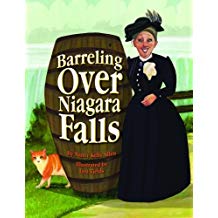
Think of rhythm in terms of music. Listening to the upbeat sound of the Rolling Stones makes me shimmy and shake. An Elton John ballad brings on the swing and sway. The beat. The cadence. The rhythm. They affect us in the same way as we read. Short phrases speed up the action as in this scene in BARRELING OVER NIAGARA FALLS: Annie jostled inside the small, dark barrel, bobbing through the rapids, slamming into rocks. The barrel pitched and rolled—forward and back, left and right, up and down—in the rough, tough bucking-bronco ride. The sentences are long but the phrasing is short with emphasis is on the short phrase.       
Longer sentences, without short phrases, slow the action. I used this method as the beginning scene in HIRAM’S GIFT: Many winters ago Hiram walked to school from deep in a holler, snuggled tight between two mountains. A lemon pie moon dangled like a giant’s lantern and lit the path. 

When you read picture books, notice the rhythm of the words. When you find a passage that you particularly like, read it aloud. Does it swing and sway? Boogie and scoot? Tap and snap?

Call for Submissions for Young Writers:

Amazing Kids! Magazine. Our award-winning, kid-created monthly online magazine is dedicated to providing kids with a fun and educational experience, a place to share their creative works, through their writing, art, and photography. Our Amazing Kids! of the Month stories feature real life kids doing some pretty amazing things! Amazing Kids! believes by reading about other kids' accomplishments, or reading their creative works, it can help inspire more kids to explore their own amazing gifts and use them to make a difference in the world.

Submission guidelines at http://amazing-kids.org/

Call for Submissions for Adult Writers:

U.S. Kids Magazines (Humpty Dumpty and Jack and Jill), providing fun, entertaining reading material is our priority. We accept humorous, playful, and witty stories that kids would love to read—not stories that grownups think kids should read.

As part of the Children’s Better Health Institute, we are always in need of high-quality stories, articles, and activities with a broad health and fitness focus. Please keep in mind that we would rather show kids living a healthy lifestyle than dictate a healthy lifestyle to our readers. In other words, health topics should be incorporated into the story or article, not be the focus of it.

Submission guidelines at http://www.uskidsmags.com/writers-guidelines/

Nancy Kelly Allen has written 48 children’s books and a cookbook, SPIRIT OF KENTUCKY: BOURBON COOKBOOK.

Leave a message or check out my blog at www.nancykellyallen.com

Sunday, June 18, 2017

Picture Book Revision, part 2

            Tips on revision, continued:

My thought processes rely heavily on verbs that don’t show action: is, are, was, were…. In revision, I eliminate many of the non-action verbs and replace them with other verbs that paint a specific picture (pedaled, skipped, barked). Action verbs don’t need modifiers, so fewer words are needed to describe the scene.
Add rhythm. Alliteration (fog floated) makes the prose livelier. Onamonapia (bumpty-bump) adds a beat that sounds like poetry when read aloud. Rhythm is how the words connect, a rise and fall of the phrases and sentences.
Less dialog. Picture books don’t rely heavily on dialog. Usually, dialog is no more than 1/3 of the text, often much less. Rather than conversations, use action scenes that can be illustrated with the narrator relating the action. The targeted audience is young children who prefer fast action to character conversation, which often slows the action. Of course, this is a general rule. Some books have no dialog, and some are all dialog.
Let the illustrations tell part of the story. Picture book writers have to think visually. When I write a first draft, I include scenes that describe illustrations. In revision, I study each word, phrase, and sentence; then, delete everything down to the bare action. Sometimes I cut so much, I have to add it again to make the story understandable. Picture books are short and the stories are to the point.
Every page in the book must show action and the pace is usually fast. After writing the first draft, I divide the manuscript into 13 scenes. Each scene must show action. If not, more revision is required.
Next week, I’ll add more tips.
Call for Submissions for Adult Writers:

Narrative is strongly committed to supporting our authors’ work. Our current rates for work are as follows:—$150 for a Story of the Week, with $400 each for the annual Top Five Stories of the Week.
—$150 to $350 for 500 to 2,000 word manuscripts.
—$350 to $1,000 for 2,000 to 15,000 word manuscripts.
—Rates for book-length works vary, depending on the length and nature of the work.
—$50 minimum for each accepted poem and audio piece. ($25 for poetry reprints.)
—$200 each for the annual Top Five Poems of the Week.FIRESIDE
Submission guidelines at http://www.narrativemagazine.com/node/360

Sunday, October 4, 2015

Writing Style

Have you ever read so many books by a writer that you recognize the style immediately. Dr. Seuss, for instance, had a specific style.

In The Cat in the Hat, the mood was fun, happy, playful. The word choice evoked lighthearted zeal.
"They are tame. Oh so tame!
They have come here to play.
They will give you some fun
On this wet, wet, wet day."
Bill Martin Jr. could not read as a child. He called his writing style “jazzy” and wrote “to a melody,” meaning that his words had a particular rhythm. Many of his books had a predictable text, such as Brown Bear, Brown Bear What Do You See? and Chicka Chicka Boom Boom.
Writing style is the way an author chooses to write to the audience. It reveals the writer’s word choice, sentence structure, and tone, all of which varies with every writer. Style is the WAY a piece is written as opposed to WHAT is written.
When you will begin writing your book, consider the style. Will the text be condensed to a few words on each page or filled with imagery and details? Will it be told in a lyrical fashion, as Bill Martin Jr. and Dr. Seuss did, straightforward text as with many nonfiction books, or maybe with a touch of humor infused into a serious piece? Will it be told in first or third person?
As you write stories, your style will emerge. The way you use written language by creating dialog and constructing sentences and paragraphs, touches of humor, playfulness in word choice all contribute to your literary individuality—your writing style.
Call for Submissions for Young Writers:
Adroit Journal. A  literary magazine run entirely by high school and college students. Adroint publishes poetry, fiction, flash fiction, art/photography, and cross-genre works with separate submissions for "adults" and those "under the age of 21."
Call for Submissions for Adult Writers:
Young Rider is a bi-monthly magazine written for children and teens who own horses or who take lessons at riding schools. Pays $150 for features of 800 to 1,000 words.